
While the world is still amazed at how a single technology can make so much happen, whether it’s solving age-old challenges or creating new opportunities for businesses across global verticals, blockchain is progressing constantly through multiple stages of development. After all, innovation is the true nature of this transformative technology.
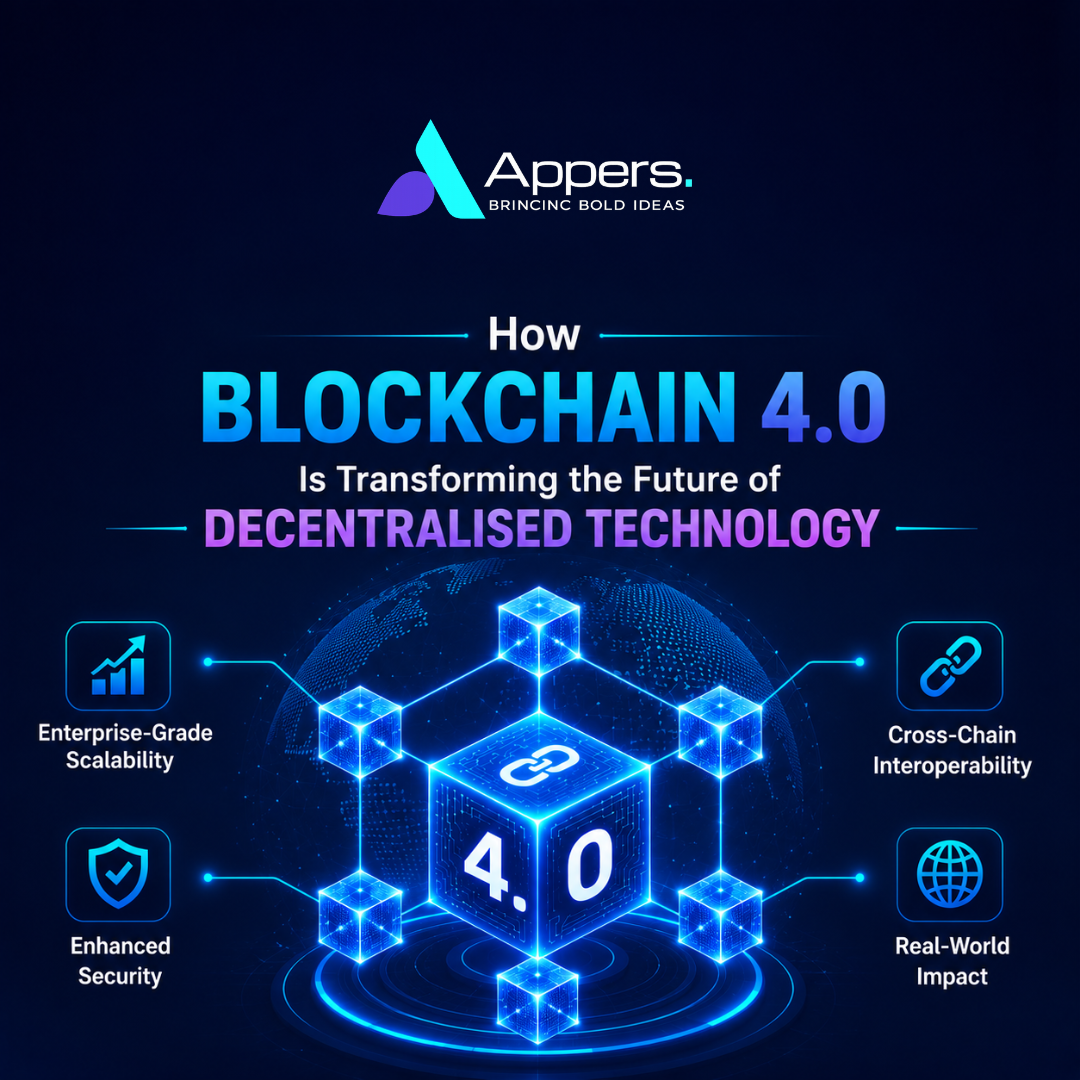
In 2026, we are witnessing the latest generation of blockchain 4.0. This updated version addresses the limitations of its predecessors by offering enterprise-grade scalability, interoperability, automation, sustainability, and much more. Let’s explore how Blockchain 4.0 is impacting the future of decentralised technology in detail.
Also Read: Why Should Enterprises Invest in Blockchain Consulting Services?
Understanding the Evolution of Blockchain
Before we get into what Blockchain 4.0 is, let’s first understand where it came from. Here’s the complete overview of all the generations of blockchain:
Blockchain 1.0: Digital Currency
Blockchain actually emerged from the world-famous digital currency, Bitcoin. That’s why most people confuse blockchain with cryptocurrency, but it’s much more than that now.
The time when Bitcoin came, it redefined traditional financial services by introducing the concept of decentralised digital money. It removed reliance on intermediaries or centralised authorities and created a secure, immutable and transparent payment system. It processed peer-to-peer transactions by utilising distributed ledgers, Proof-of-Work consensus, and decentralised validation.
Despite all of this, Blockchain 1.0 had limited functionality and only supported financial transactions.
Blockchain 2.0: Smart Contracts
Just like Bitcoin was the initiator of Blockchain 1.0, Ethereum introduced Blockchain 2.0. This decentralised blockchain network actually made it possible to create blockchain-powered digital agreements, known as smart contracts. These programmable agreements can automatically execute tasks when predefined conditions are met.
This remarkable development helped blockchain extend its functionalities beyond financial transactions and created use cases across various industries such as real estate tokenisation, supply chain management solutions, decentralised finance (DeFi), and more.
Though Ethereum delivered a technical foundation for tech professionals to leverage smart contract automation, it created limitations due to the Ethereum Virtual Machine (EVM) and its Proof-of-Work (PoW) consensus mechanism. There were multiple issues like scalability, high transaction fees, and network congestion.
Blockchain 3.0: (Decentralised Applications or DApps)
Blockchain 2.0 created the opportunity for dApps. Yet, the third generation of blockchain actually fuelled the development of decentralised applications by integrating smart contracts with user-friendly interfaces. Since they are managed by distributed ledger technology rather than a centralised authority, these apps are a major upgrade over traditional web applications. dApps feature transparency, security, and decentralisation and solve real-world problems in different sectors through industry-specific blockchain solutions.
Apart from Ethereum, Blockchain 3.0 offered multiple network options to build decentralised infrastructure to overcome Ethereum-specific challenges and improve usability. Most importantly, the expansion of multiple consensus mechanisms, such as Proof of Stake (PoS) and Delegated Proof of Stake (DPoS), helped to reduce limited scalability, network congestion, and high energy consumption issues.
Moreover, each blockchain network, whether it is Solana, Polygon, or many more, has its own set of capabilities, which even led to greater diversity in blockchain app development. Despite this, these applications had limited scalability, lacked interoperability, and provided a poor user experience.
Understanding Blockchain 4.0
Blockchain 4.0 is the next generation of decentralised technology truly designed for greater practical utility and enterprise adoption. It eliminates all of the complexities of previous generations of blockchain and supports real-world business operations at scale. Along with the main decentralisation feature, Blockchain 4.0 offers automated, scalable, efficient, and interoperable digital infrastructure that creates a user-friendly environment.
Now, this upgrade actually occurred through the emergence of interoperability protocols, scaling solutions, and more. Also, Blockchain 4.0 integrates its capabilities with emerging technologies such as artificial intelligence (AI), IoT, edge computing, and cloud infrastructure to create intelligent decentralised ecosystems.
While previous dApps operated in silos, the distributed architectures of Blockchain 4.0 allow smooth integration with legacy business environments to incorporate decentralisation.
Key Features of Blockchain 4.0
Blockchain 4.0 makes decentralised technology more practical for enterprise adoption and large-scale applications due to the following defining features of Blockchain 4.0:
Enterprise-Grade Scalability
Blockchain 4.0 overcomes scalability issues by leveraging advanced consensus mechanisms, Layer-2 scaling solutions, sharding, and modular blockchain architectures. These advancements allow the networks to process thousands and thousands of transactions per second without impacting the speed or even security of the platform.
Thus, Blockchain 4.0 is more suitable for industries that deal with a high user base such as banking, healthcare, logistics, and e-commerce.
Cross-Chain Interoperability
Modern decentralised networks feature cross-chain interoperability due to the incorporation of interoperability protocols. It helps the exchange of data or digital assets across different ecosystems.
Thus, Blockchain 4.0 allows businesses to build various blockchain platforms and create a unified ecosystem, as well as allow them to interact with other market platforms to improve collaboration and operational efficiency.
Seamless Integration with Emerging Technologies
Blockchain 4.0 can work alongside technologies such as AI, Internet of Things (IoT), cloud computing, edge computing, and big data analytics, which all together enhance its capabilities. Especially, the integration of AI allows improved data accuracy, reduced manual intervention, anomaly detection, and simplified complex workflows.
Improved Security and Privacy
Blockchain 4.0 took the security of the decentralised technologies even one step further by employing advanced cryptographic technologies. The implementation of Zero-Knowledge Proofs (ZKPs), decentralised identity (DID), and multi-layer security protocols helps protect sensitive information without impacting the transparency of distributed ledger record-keeping.
Applications of Blockchain 4.0
Blockchain 4.0 is offering a wide range of applications, as explained below:
Web 3.0
Blockchain 4.0 is acting as the key innovation in Web 3.0 development. It provides powerful decentralised infrastructure to support decentralised applications (dApps), digital identities, NFTs, DAOs, and DeFi platforms. Blockchain 4.0 improves scalability and interoperability in Web3 applications and also provides user-centric experiences.
Industry 4.0
This fourth generation of blockchain is also powering the fourth industrial revolution. It is empowering industries to benefit from secure data sharing, smart contract automation, and real-time asset tracking in their management systems.
DePIN (Decentralised Physical Infrastructure Networks)
Employing Blockchain 4.0, DePIN helps businesses to decentralise ownership and management of their physical infrastructure. These frameworks use smart contracts to automate rewards and transparent ledgers to validate contributions.
Metaverse
Blockchain 4.0, along with other modern technologies like AI, IoT, AR/VR, and many more, is being used to build metaverse spaces. These platforms blend physical and virtual realities to create immersive experiences.
Challenges With Blockchain 4.0 Adoption
Indeed, Blockchain 4.0 has huge potential; still, it also presents some challenges, like the following:
- Even though the Australian government encourages blockchain adoption, certain countries still have regulatory uncertainties surrounding blockchain innovation.
- As blockchain continues to evolve rapidly, with Blockchain 4.0 being its most refined version yet, implementation has become increasingly complex. It requires extensive blockchain expertise to effectively integrate and manage modern decentralised networks.
- Successfully integrating Blockchain 4.0 with legacy systems comes with extremely high deployment costs.
Conclusion
Thus, the emergence of blockchain 4.0 is playing a huge role in the evolution of decentralised technology. It is helping deal with its traditional implementation challenges and turning blockchain from a niche innovation into a practical foundation for digital transformation across global industries.
Are you ready to experience what this innovative technology can do for your enterprise? Appers can assist you! We are a leading Blockchain Development Company in Australia, helping global enterprises adopt decentralised technologies and leverage real value from professional implementation. We provide end-to-end blockchain development services, assisting from ideation all the way to actual platform development, testing, deployment and beyond.
Get in touch with our experts today to discover how blockchain 4.0 can speed your digital transformation and bring long-term business growth.
Also Read: How to Build a Blockchain Application: Step-by-Step Development Guide

