
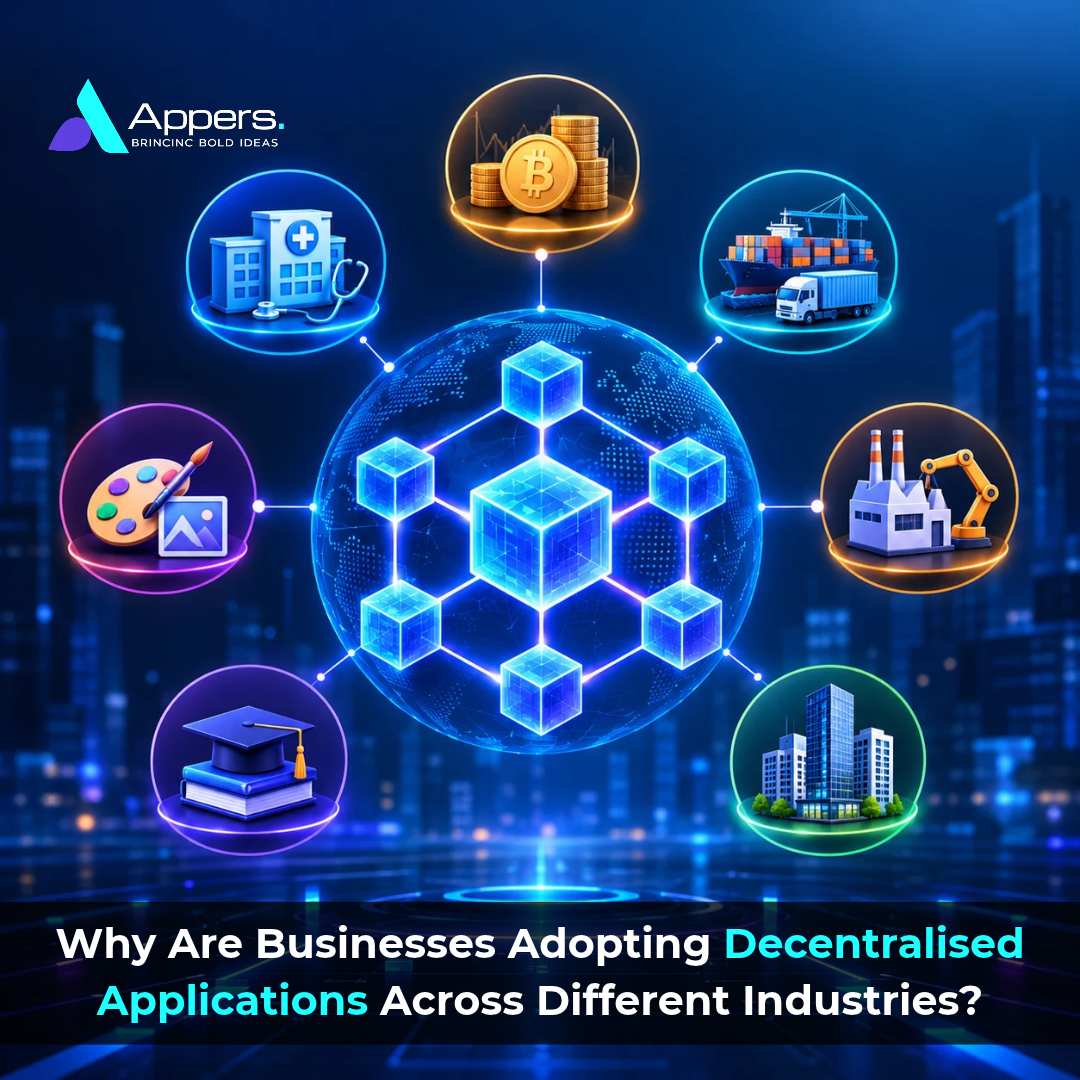
Businesses are constantly exploring new technologies to improve operational efficiency, strengthen security, increase transparency, and deliver better customer experiences. As digital transformation continues across industries, blockchain technology has emerged as an important innovation for organisations seeking alternatives to traditional application models. One technology gaining attention is the decentralised application, commonly known as a dApp.
Unlike conventional applications that typically depend on centrally managed servers and databases, decentralised applications use blockchain networks, smart contracts, and distributed infrastructure to support specific operations. Depending on their design, they can help businesses automate processes, improve transaction transparency, reduce reliance on intermediaries, and provide users with greater control over digital assets.
From finance and healthcare to supply chain management, gaming, real estate, and digital identity, dApps are creating new opportunities for businesses. However, their suitability depends on each organisation’s objectives, regulatory requirements, technical capabilities, and the needs of its users.
Understanding why businesses are adopting decentralised applications can help organisations determine where this technology may deliver meaningful value.
Also Read: How Can a Web3 Development Company Help Businesses Build Decentralized Applications?
What Are Decentralised Applications?
Decentralised applications are software applications that use blockchain networks or other distributed technologies to execute some or all of their operations. Unlike traditional applications, which generally rely on a central authority to manage application data and business logic, dApps can distribute these functions across a network of participants.
Many dApps use smart contracts to execute predefined instructions automatically when specified conditions are met. For example, a decentralised financial application may use a smart contract to process a transaction according to established rules without requiring a central intermediary to approve every operation.
A typical dApp may include three main components:
-
Blockchain Network: Records transactions or application data across a distributed network.
-
Smart Contracts: Execute predefined business rules and automate supported operations.
-
User Interface: Allows customers, employees, or business partners to interact with the application.
Not every dApp is entirely decentralised. Some applications use blockchain technology for specific functions while relying on conventional servers, cloud infrastructure, or centralised databases for other operations.
This flexible architecture allows businesses to evaluate decentralisation according to their operational requirements rather than replacing their entire technology infrastructure.
1. Improved Security And Data Integrity
Security is a major consideration for organisations managing sensitive information, financial transactions, and digital assets. Traditional applications can become attractive targets for cybercriminals when critical systems or databases are concentrated within a central infrastructure.
Blockchain-based applications offer an alternative approach by distributing transaction records across network participants. Depending on the blockchain protocol, cryptographic techniques, consensus mechanisms, and network configuration, unauthorised changes to confirmed records can be difficult to execute without detection.
Smart contracts can also enforce predefined rules for transactions and application interactions. This helps reduce certain types of manual errors and supports consistent execution of business logic.
For example, a supply chain application could record product movements and ownership transfers on a blockchain, allowing authorised participants to verify transaction histories.
However, decentralisation does not automatically guarantee complete security. Smart contract vulnerabilities, compromised user credentials, insecure interfaces, and poorly configured systems can still create risks. Businesses need security audits, access controls, ongoing monitoring, and appropriate data protection measures to safeguard their applications.
2. Greater Transparency And Accountability
Transparency is another important reason organisations are exploring decentralised applications. In conventional business environments, different departments or partner organisations may maintain separate records of the same transactions. Reconciling these records can create delays, disagreements, and additional administrative work.
A blockchain-based application can provide participants with access to a shared transaction history, subject to the network’s permissions and privacy configuration.
For instance, manufacturers, distributors, logistics providers, and retailers can use a decentralised application to record supply chain activities. Each authorised participant can verify relevant events without relying entirely on a single organisation’s internal database.
Similarly, businesses involved in digital asset transfers can use blockchain records to verify transaction activity and ownership changes.
This shared recordkeeping approach can improve accountability, simplify audits, and reduce disputes caused by inconsistent information.
Nevertheless, transparency must be balanced with confidentiality. Public blockchain transactions may expose information that businesses would prefer to keep private. Organisations should carefully assess whether a public, private, or permissioned blockchain is appropriate for their operations.
3. Automation Through Smart Contracts
Manual processes often consume valuable time and resources, particularly when transactions require several approvals or involve multiple parties.
Smart contracts allow businesses to automate certain activities by executing predefined instructions when specified conditions are satisfied.
For example, a smart contract used in supply chain management could initiate a payment after an agreed delivery confirmation is recorded. In a digital marketplace, a contract could distribute payments according to predefined rules. In decentralised finance, smart contracts can support lending, borrowing, and other financial operations.
Automation can offer several advantages:
-
Reduce repetitive administrative tasks.
-
Apply business rules consistently.
-
Improve transaction processing efficiency.
-
Minimise selected manual errors.
-
Provide verifiable records of contract execution.
However, smart contracts cannot independently verify every real-world event. They may require trusted data feeds, known as oracles, to obtain information such as delivery status, market prices, or external confirmations.
Businesses must also consider how contract errors will be corrected, how upgrades will be managed, and whether transactions can be reversed when disputes arise.
4. New Opportunities In Financial Services
Financial services are among the most recognised areas for decentralised application adoption. Businesses are exploring blockchain-based solutions for digital payments, asset transfers, tokenisation, lending, and financial recordkeeping.
Decentralised finance applications can support certain financial activities through smart contracts rather than relying exclusively on traditional intermediaries. Depending on the platform, users may interact with digital assets, access liquidity, or execute transactions directly through blockchain infrastructure.
Cross-border payments are another area where blockchain technology is attracting attention. Certain blockchain-based systems can facilitate digital asset transfers across geographical boundaries, potentially improving transaction visibility and settlement efficiency.
However, blockchain transactions are not automatically cheaper or faster than conventional payment methods. Network fees, liquidity requirements, currency conversion, compliance checks, and conversion between digital assets and traditional currencies can affect the overall experience.
Businesses operating in financial services must also consider anti-money laundering requirements, customer verification, consumer protection, licensing obligations, and applicable financial regulations.
Consequently, decentralised applications should be evaluated against the specific needs of the payment system, rather than assumed to be a universal replacement for established financial infrastructure.
5. Better Traceability In Supply Chain Management
Supply chains frequently involve multiple organisations, geographical locations, and information systems. Tracking products across these networks can become difficult when participants use disconnected databases or inconsistent reporting processes.
Decentralised applications can help create shared records of product movements, ownership changes, certifications, and delivery events.
For example, a food distributor could record product origins, processing milestones, and shipping information on a blockchain-based platform. Retailers and other authorised participants could then verify the recorded information throughout the supply chain.
This approach can help organisations identify discrepancies, investigate product recalls, and improve coordination between business partners.
In manufacturing, blockchain applications can also support records relating to component sourcing, product authenticity, and maintenance history.
The effectiveness of these systems depends on the quality of the information entered into them. A blockchain can preserve recorded data, but it cannot automatically guarantee that information supplied by a person, sensor, or external system is accurate.
6. Innovation In Healthcare And Digital Identity
Healthcare organisations manage sensitive patient information across hospitals, laboratories, pharmacies, insurers, and other service providers. Differences between information systems can make secure information sharing challenging.
Blockchain-based applications may support healthcare workflows by maintaining verifiable records of consent, data access, and selected administrative events. They can also help track pharmaceutical supply chains and verify product provenance.
However, storing sensitive patient information directly on a public blockchain can create privacy and regulatory concerns. A more suitable architecture may keep medical records in secure, authorised systems while storing only limited verification information or references on a blockchain.
Digital identity is another potential application. Decentralised identity solutions can allow individuals or organisations to present verifiable credentials without depending entirely on a single identity provider.
For example, an application could help verify qualifications, professional certifications, or other approved credentials. Users may be able to share specific information with a service provider rather than disclose an entire document.
These systems require careful consideration of consent, identity verification, credential revocation, data protection, and applicable healthcare or identity regulations.
7. Growth In Gaming, Digital Assets, And Real Estate
The gaming and digital entertainment industries are exploring decentralised applications to support digital ownership, in-game assets, and blockchain-based marketplaces.
Some blockchain games allow users to hold digital assets in compatible wallets and transfer supported assets between participants. This differs from conventional games, where ownership and transfers are generally controlled by the game publisher.
Real estate businesses are also investigating blockchain-based applications for property records, digital representations of assets, and fractional ownership models. Tokenisation may allow eligible assets or associated rights to be represented digitally, subject to legal and regulatory requirements.
For example, a platform could use blockchain records to track transfers of tokenised interests in an asset. Smart contracts may automate certain administrative processes, depending on the platform’s design.
Nevertheless, a digital token does not automatically establish legal ownership of a physical property. Enforceable rights, property laws, investor protections, and regulatory requirements must be addressed before launching such solutions.
8. Reduced Dependence On Centralised Infrastructure
Traditional applications often depend on a central service provider to maintain databases, approve transactions, or control access to particular functions. While centralised systems can be efficient and easier to manage, they may introduce single points of failure or create dependencies on a particular organisation.
Decentralised applications can distribute selected responsibilities across multiple network participants. Depending on the architecture, this may improve resilience and reduce reliance on one central authority.
Businesses can also use decentralised governance models to allow eligible participants to contribute to decisions about application upgrades, operational rules, or ecosystem development.
However, distributed infrastructure can introduce additional complexity. Network performance, transaction costs, governance disagreements, and software upgrades may affect reliability and usability.
Businesses should therefore compare decentralised and conventional architectures before making a decision. In many cases, a hybrid application that combines blockchain components with established cloud services may offer the most practical solution.
How Can Businesses Get Started With dApp Development?
Successful dApp adoption begins with a clear business objective rather than selecting blockchain technology simply because it is gaining attention.
Organisations should identify the operational challenge they want to solve, determine whether multiple parties need a shared source of truth, and evaluate whether decentralisation offers advantages over a conventional application.
A structured implementation process generally includes the following steps:
-
Identify Business Requirements: Define the target users, business challenges, expected outcomes, and measurable performance indicators.
-
Choose An Appropriate Blockchain: Evaluate public and permissioned networks according to scalability, costs, privacy, governance, and ecosystem compatibility.
-
Plan the Architecture: Determine how smart contracts, databases, APIs, wallets, and user interfaces will work together.
-
Develop and Test Smart Contracts: Conduct functional testing, security reviews, and independent audits where appropriate.
-
Address Compliance and Privacy: Review applicable regulations, data retention requirements, access controls, and transaction monitoring.
-
Launch and Maintain the Application: Monitor performance, manage upgrades, resolve vulnerabilities, and collect user feedback.
Businesses should also consider usability, onboarding, transaction fees, and integration with existing systems. Even a technically advanced dApp may struggle to achieve adoption if it is difficult for customers or employees to use.
How Appers Supports Decentralised Application Development
Appers is a dApp development company in Australia that helps businesses explore and implement decentralised application solutions. Its services can support organisations looking to translate blockchain concepts into practical applications aligned with their operational goals.
From initial consultation and solution planning to application design, Smart Contract Development, testing, and deployment, a structured development approach helps businesses assess the technical and commercial requirements of blockchain projects.
Organisations considering dApp development should prioritise solutions that address genuine business needs, provide a clear user experience, and incorporate security and compliance considerations from the beginning.
Working with an experienced development team can help businesses evaluate suitable blockchain platforms, establish an appropriate application architecture, and plan for ongoing maintenance as their requirements evolve.
Conclusion
Businesses are adopting decentralised applications across different industries because they offer new ways to manage digital transactions, automate workflows, improve record transparency, and support digital ownership. Their potential applications extend across finance, supply chains, healthcare, gaming, real estate, and identity management.
However, dApps are not the right solution for every business challenge. Their success depends on choosing appropriate use cases, managing security and privacy risks, meeting regulatory requirements, and delivering measurable operational value.
By evaluating these factors carefully, organisations can determine where decentralised applications fit into their digital strategies. With support from a capable dApp Development Company such as Appers, businesses can explore blockchain-powered solutions designed around their specific needs and long-term objectives.
Also Read: How Does a Smart Contract Development Company Automate Business Operations?

