
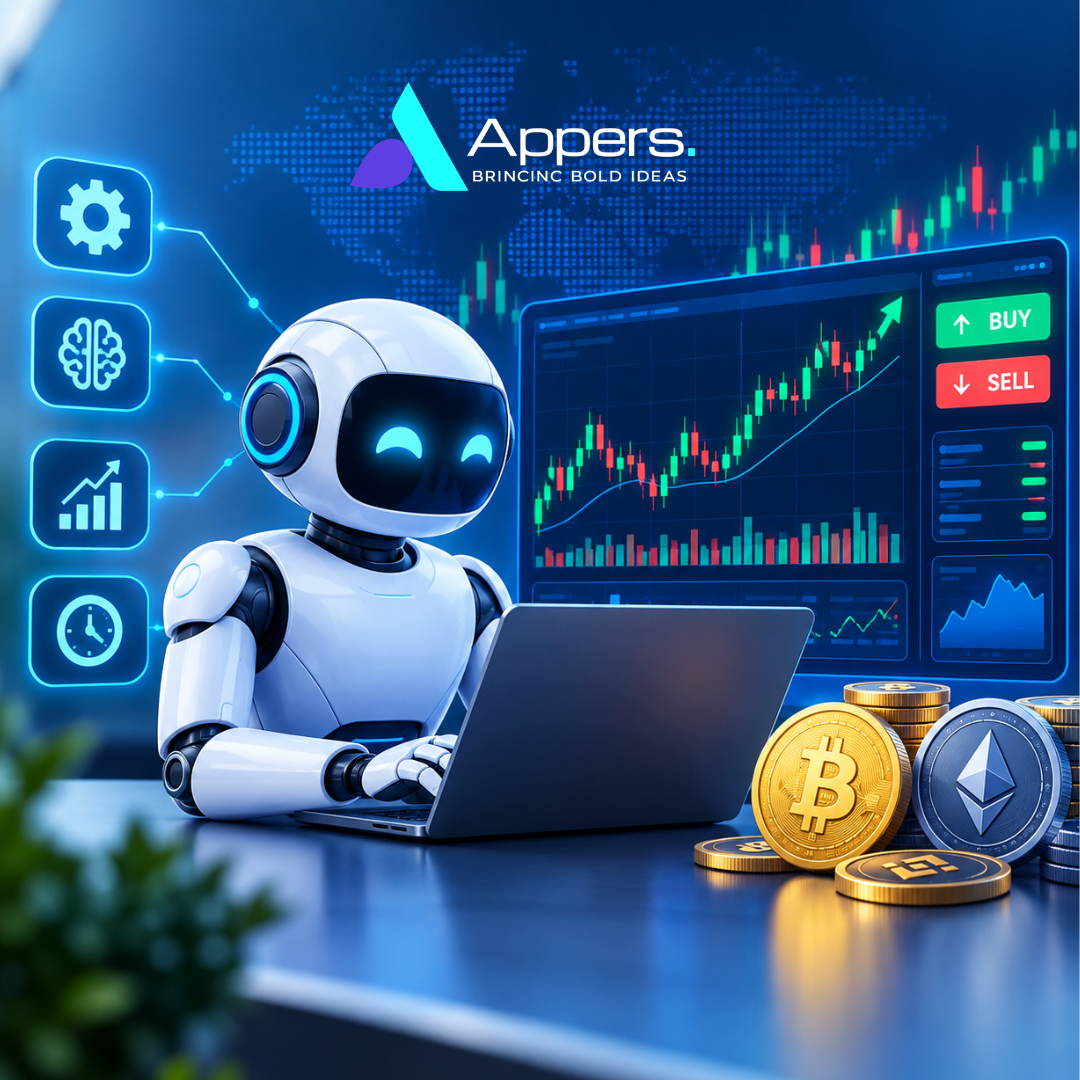
The cryptocurrency market operates 24/7, creating continuous opportunities for traders but also making it challenging to monitor price movements and execute trades manually. Traders need to analyse market data, identify potential opportunities, and respond quickly to changing conditions. This is where automated trading solutions can make a significant difference.
A Crypto Trading Bot Development Company can transform predefined trading strategies into automated software that monitors market conditions, generates signals, and executes trades based on programmed rules. With the right technology, businesses can build customised trading bots designed around specific strategies, risk parameters, and operational requirements.
Also Read: Why Are Smart Contracts Important for Enterprise Solutions?
What Is a Crypto Trading Bot?
A crypto trading bot is a software application that automates trading activities using predefined rules and algorithms. Instead of manually monitoring charts and placing every order, users can configure the bot to respond automatically when specific market conditions occur.
For example, a trading bot may be programmed to purchase an asset when its price reaches a particular level and sell it when a predefined profit target is achieved. More advanced bots can combine multiple indicators, market signals, and risk-management parameters before executing an order.
The primary purpose of a trading bot is not to predict the market independently but to consistently execute a defined strategy without requiring continuous manual intervention.
How Can a Crypto Trading Bot Development Company Automate a Trading Strategy?
Automating a trading strategy involves converting trading logic into a structured software system. A development company can manage this process through several key components.
1. Understanding and Defining the Trading Strategy
The first stage is converting the trading concept into clear and measurable rules. Developers work around the strategy’s entry conditions, exit conditions, indicators, trading pairs, timeframes, and risk parameters.
Strategies can be based on various approaches, including:
- Moving-average crossovers
- RSI-based signals
- Trend-following
- Grid trading
- Arbitrage
- Momentum-based strategies
- Price-based triggers
- Technical indicators
Once the strategy is clearly defined, developers can translate each condition into programmable logic.
2. Connecting With Cryptocurrency Exchanges
A trading bot requires access to real-time market information and trading functionality. Exchange APIs allow the bot to communicate with supported cryptocurrency exchanges.
Through API integrations, the system can access information such as:
- Live cryptocurrency prices
- Trading volume
- Order-book information
- Historical market data
- Account balances
- Open orders
- Order status
The bot can continuously process this information and compare it against the conditions established within the trading strategy.
3. Generating Automated Trading Signals
After receiving market data, the trading engine evaluates whether predefined conditions have been met.
For example, a strategy may require a specific relationship between two moving averages before generating a buy or sell signal. Instead of manually monitoring the chart, the bot can perform this analysis automatically.
This allows trading strategies to operate systematically and reduces the need for repetitive monitoring.
4. Executing Orders Automatically
Once a valid trading signal is generated, the bot can send an order through the connected exchange API.
Depending on the platform’s requirements, the trading system may support different order types, including:
- Market orders
- Limit orders
- Stop orders
- Stop-loss orders
- Take-profit orders
Automated execution can help reduce the time between identifying a predefined trading condition and placing an order. However, actual execution can still be affected by liquidity, exchange availability, network conditions, API response times, and market volatility.
How Can Trading Bots Incorporate Risk Management?
Risk management is an important component of automated trading software. A professionally developed trading bot can incorporate predefined controls that determine how much capital can be allocated to a trade and when positions should be reduced or closed.
Common risk-management features include:
- Stop-loss configuration
- Take-profit levels
- Maximum trade size
- Position limits
- Daily trading limits
- Maximum exposure per asset
- Portfolio allocation rules
For example, a business may configure the system to limit the amount of capital allocated to a particular trading pair. These controls allow the bot to follow a predetermined risk framework rather than executing unlimited trades.
Can Trading Bots Automate Multiple Strategies?
Modern trading platforms can be designed to support multiple trading strategies. Instead of relying on a single trading model, businesses can create separate strategies for different assets, trading pairs, or market conditions.
For instance, one strategy could use grid trading while another relies on technical indicators. A modular architecture can allow individual strategies to be added, modified, tested, or disabled without affecting the entire trading platform.
This flexibility is particularly useful for businesses that want to expand their automated trading capabilities over time.
Why Is Backtesting Important for Automated Trading?
Before deploying a trading strategy in a live environment, backtesting can provide valuable insights into how the strategy would have performed using historical market data.
A backtesting engine can evaluate predefined rules against historical price movements and generate performance information such as:
- Number of trades
- Winning and losing trades
- Historical returns
- Maximum drawdown
- Entry and exit points
- Strategy performance over different periods
Backtesting can help developers and strategy owners identify potential issues before live deployment. However, historical results should not be interpreted as a guarantee of future performance because cryptocurrency markets can change rapidly.
What Technology Is Used to Build Crypto Trading Bots?
A complete crypto trading bot generally consists of several interconnected components. These may include a trading engine, exchange API integrations, database systems, user dashboards, authentication mechanisms, monitoring tools, notification systems, and security infrastructure.
Real-time data processing is particularly important because trading decisions may depend on rapidly changing market information. Cloud infrastructure can also support scalability when a platform needs to process larger volumes of market data or support more users and trading activities.
Security should remain a core consideration throughout development. Since trading bots may interact with exchange accounts and API credentials, developers should implement appropriate authentication, encryption, access controls, secure credential management, and monitoring mechanisms.
How Does Appers Support Crypto Trading Bot Development?
Appers helps businesses turn their cryptocurrency trading concepts into customised digital trading solutions. Its development approach can cover essential components such as trading strategy implementation, exchange API integration, automated execution, risk-management functionality, dashboards, testing, and deployment.
By combining automated trading logic with a scalable software architecture, Appers can help businesses build trading bot solutions around their specific operational requirements. The technology stack, features, integrations, and architecture can be customised according to the intended use case and target audience.
For businesses planning to develop a custom crypto trading platform, this approach can provide greater flexibility compared with relying entirely on generic trading software.
What Should Businesses Consider Before Developing a Crypto Trading Bot?
Businesses should define their requirements carefully before beginning development. Important considerations include the exchanges that need to be supported, trading strategies, asset classes, order types, risk controls, user requirements, scalability, security, and monitoring capabilities.
Regulatory and compliance requirements should also be reviewed based on the business model and jurisdictions involved.
Most importantly, automation should not be confused with guaranteed profitability. A trading bot follows programmed instructions, while market outcomes remain uncertain. The effectiveness of an automated system depends on the strategy, implementation, market conditions, execution environment, and risk-management framework.
Conclusion
A Crypto Trading Bot Development Company can automate a trading strategy by transforming predefined rules into software capable of monitoring market data, identifying trading signals, managing predefined risk parameters, and executing orders through exchange APIs.
From strategy development and backtesting to automated execution, monitoring, and security, a well-designed trading bot can streamline repetitive trading processes and provide a systematic way to implement trading strategies.
With its focus on customised software solutions, Appers can help businesses develop crypto trading bot solutions tailored to their strategies, exchange integrations, operational requirements, and scalability goals. As cryptocurrency markets continue to evolve, automated trading technology can provide businesses with a structured framework for implementing and managing rule-based trading workflows.
Also Read: Why Should Enterprises Consider Web3 Development in 2027?

